
Field Sobriety Tests: Know Your Rights Before You Comply
Know your rights at a DUI stop. Call (833)-248-4565 for a free case review and connect with a local attorney who can explain your options.

You see the flashing lights in your rearview mirror. Your heart pounds as the officer approaches your window. After a few questions, the request comes: "Step out of the car and perform a few tests for me." What happens next can shape the course of a DUI case, your driving privileges, and your finances. Understanding field sobriety tests and your rights is not about learning tricks to beat a charge. It is about knowing what the officer is looking for, what you can legally decline, and how to protect yourself in a high-pressure moment. This guide breaks down the three standardized tests, the legal landscape around refusal, the ways results can be challenged, and the practical steps to take after the stop.
The Three Standardized Field Sobriety Tests and What Officers Look For
Most drivers have heard of "walking the line" or "saying the alphabet backwards." But the National Highway Traffic Safety Administration (NHTSA) has established a specific battery of three standardized field sobriety tests (SFSTs) that are widely used across the country. These tests are not random; they are designed to detect specific impairment cues. Officers who administer them are supposed to follow strict protocols regarding instructions, scoring, and environmental conditions. When those protocols are not followed, the reliability of the results drops significantly.
The first test is the Horizontal Gaze Nystagmus (HGN) test. Nystagmus is the involuntary jerking of the eyes as they gaze to the side. The officer asks you to follow a small object (like a pen or flashlight) with your eyes while keeping your head still. The officer looks for three clues in each eye: whether the jerking begins before the eye reaches a certain angle, whether the jerking is distinct at maximum deviation, and whether the eye cannot smoothly follow the object. The theory is that alcohol consumption can exaggerate nystagmus. However, this test is highly technical, and officers often administer it incorrectly by moving the stimulus too fast, holding it too high, or failing to check for resting nystagmus.
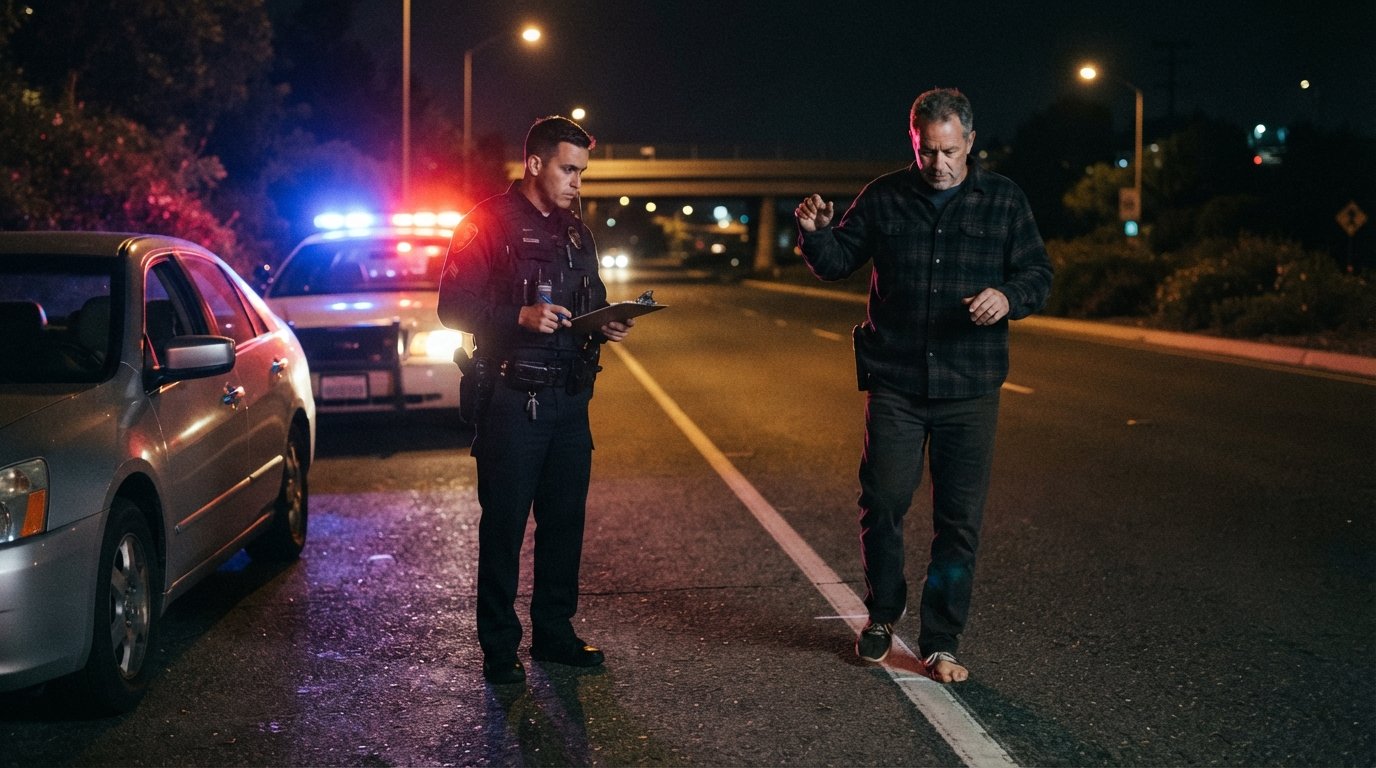
The second test is the Walk-and-Turn. The officer instructs you to take nine heel-to-toe steps along a straight line, turn around using a specific pivot, and take nine steps back. The officer watches for eight specific clues: whether you can keep your balance during instructions, whether you start too soon, whether you stop while walking, whether you miss the heel-to-toe contact, whether you step off the line, whether you use your arms for balance, whether you turn improperly, or whether you take the wrong number of steps. The test is divided attention, meaning you must listen to instructions while performing a physical task. Even sober people can struggle with this, especially on uneven pavement or in uncomfortable shoes.
The third test is the One-Leg Stand. You are asked to stand with one foot approximately six inches off the ground, look at your elevated foot, and count aloud by thousands (one thousand one, one thousand two, etc.) until told to stop, which is typically about thirty seconds. The officer looks for four clues: swaying while balancing, using your arms for balance, hopping to maintain balance, or putting your foot down. Again, divided attention is key, and the officer is supposed to time the test accurately. If the officer miscounts or does not time the thirty seconds correctly, the results are suspect.
What officers look for across all three tests is a combination of physical and cognitive impairment cues. They are not just checking whether you can walk a line; they are checking whether you can process instructions, maintain composure, and execute a physical task under stress. However, the tests are subjective. The officer decides whether you swayed, whether you stepped off the line, or whether your eyes jerked. That subjectivity is one of the primary reasons these tests can be challenged in court.
Are You Required to Participate in Field Sobriety Tests?
This is the question that weighs on most drivers' minds, and the answer is not as simple as a yes or no. In the United States, the legality of field sobriety tests is governed by state law. In most states, you are not legally required to submit to field sobriety tests. They are voluntary. However, the consequences of refusal vary dramatically depending on where you are and what type of test you are refusing.
It is critical to distinguish between field sobriety tests and chemical tests (breath, blood, or urine tests). Field sobriety tests are the physical coordination tests performed at the roadside. Chemical tests are used to measure your blood alcohol concentration (BAC). Most states have implied consent laws that require you to submit to a chemical test after a lawful arrest for DUI. If you refuse a chemical test, you can face automatic license suspension and other penalties, even if you are ultimately acquitted of the DUI charge. But field sobriety tests are different. In many states, refusing to perform the physical tests is not a violation of the implied consent law, though some states do have penalties for refusing all tests.
So what happens if you decline? In most states, the officer cannot force you to perform the physical tests. However, the officer may treat your refusal as evidence of impairment or use it to justify an arrest. Prosecutors may argue that a sober person would have no reason to refuse. But that is an argument, not a legal presumption. The key is that you have the right to decline, but you must do so politely and clearly. Saying "I do not consent to field sobriety tests" is different from remaining silent or being argumentative.
Before you make a decision, you should know how your state handles refusals. Some states, like California, do not penalize you for refusing field sobriety tests, but the officer can still arrest you based on other observations (smell of alcohol, slurred speech, erratic driving). Other states may have different rules. Because the law varies so widely, it is worth consulting a local DUI attorney or a service like CheapInjuryLawyer to understand the specific consequences in your jurisdiction. The bottom line is that participation is usually voluntary, but refusal is not a magic bullet. It is a strategic decision that depends on the circumstances and state law.
How Field Sobriety Test Results Can Be Challenged
Even if you perform the tests, the results are not set in stone. Field sobriety tests are notoriously unreliable when not administered correctly, and there are several grounds for challenging their validity in court. A skilled DUI defense attorney will scrutinize the administration of the tests, the environmental conditions, and the officer's training records.
One of the most common challenges is the officer's failure to follow NHTSA guidelines. The standardized tests have specific protocols for how instructions are given, how the tests are demonstrated, and how the clues are scored. If the officer deviated from those protocols, the test results may be inadmissible or given little weight. For example, if the officer did not properly demonstrate the Walk-and-Turn, or if the officer did not check for resting nystagmus before the HGN test, the results can be attacked.
Environmental factors also play a significant role. The tests are often administered on the side of a road, at night, with flashing lights, uneven pavement, and poor weather. These conditions can affect anyone's balance and coordination. A sober person wearing heels or boots on a sloped shoulder of a highway may struggle to walk a straight line. The officer may not note these conditions in the report, but a defense attorney can bring them to light.
Another challenge is the officer's training and experience. Not all officers are certified to administer SFSTs, and even those who are may have limited field experience. The defense can request the officer's training records, including the score on the certification exam and the frequency of refresher courses. If the officer has a history of poor test administration, that can undermine the prosecution's case.
Finally, the subjectivity of scoring is a major vulnerability. The officer decides whether a clue is present or absent. Two officers watching the same test might score it differently. This subjectivity is why video evidence (if available) is so valuable. If the dashboard camera footage shows you performing the tests without obvious difficulty, it can contradict the officer's written report. Defense attorneys often use this discrepancy to create reasonable doubt.
What to Document After a DUI Stop
If you are stopped and asked to perform field sobriety tests, the moments after the encounter are crucial for building a defense. Your memory will fade, and the officer's report will be the primary narrative. To protect your rights, you should document as much as you can as soon as possible. This does not mean you should argue with the officer or refuse to provide identification. It means you should be a careful observer and record details while they are fresh.
Here is a practical checklist of what to document after a DUI stop. This list is not legal advice, but it can help you and your attorney reconstruct the events.
- Location and time: Note the exact location of the stop (street address, mile marker, landmarks) and the time. This helps establish the environment (lighting, traffic, weather) and can be used to challenge the officer's observations.
- Instructions given: Write down the instructions the officer gave you for each test. Did the officer demonstrate the test? Did the officer ask if you understood? Were the instructions clear or confusing?
- Conditions of the test area: Describe the surface where you performed the tests (uneven pavement, gravel, slope, wet ground). Note the lighting (dark, flashing lights, headlights) and weather (rain, wind, cold).
- Your physical condition: Note any factors that could affect your performance, such as fatigue, medical conditions, injuries, footwear, or nervousness. If you have a medical condition that affects balance or coordination, document it.
- Officer's behavior and statements: Record what the officer said to you, including any promises or threats. Note whether the officer was polite, aggressive, or confusing. If the officer asked you to take a chemical test, note the exact phrasing of the request and your response.
After the stop, you should also preserve any evidence you can. If you have a passenger, ask them to write down what they observed. If there are businesses or homes nearby with security cameras, your attorney may be able to obtain footage. If you were injured or felt ill, seek medical attention and keep the records. All of this information can be valuable in challenging the field sobriety test results or the arrest itself.
It is also important to write down your own account of the stop as soon as possible. Do not rely on your memory weeks later. Write a detailed narrative while it is fresh, and share it with your attorney. This contemporaneous record can be used to cross-examine the officer and highlight inconsistencies in the official report.
Why State Law Controls the Specifics of Field Sobriety Tests
One of the biggest mistakes drivers make is assuming that the rules are the same everywhere. In reality, DUI law is a patchwork of state statutes, court decisions, and local practices. The legality of field sobriety tests, the consequences of refusal, and the procedures for challenging evidence all depend on the state where you were stopped. Understanding field sobriety tests and your rights requires a state-specific analysis.
For example, some states have statutes that explicitly state that field sobriety tests are voluntary, while others have implied consent laws that cover all tests, including physical ones. Some states require officers to advise drivers of their right to refuse, while others do not. The penalties for refusing a chemical test vary from a short license suspension to a longer one, and the lookback periods for prior offenses differ. Even the admissibility of the HGN test varies; some courts accept it as evidence of impairment, while others require a foundational hearing to establish its reliability.
Because of this variation, generic advice found online can be misleading. A strategy that works in one state may backfire in another. For instance, in some states, refusing all tests can lead to a longer license suspension than taking the test and failing. In others, refusing the field tests but agreeing to a breath test is a common approach. The only way to know the right approach is to consult the law in your state or speak with an attorney who practices there.
This is where a service like GoFreeLegal.com can help. GoFreeLegal is not a law firm and does not provide legal advice, but it offers a free, confidential way to describe your situation and get connected with participating DUI defense attorneys in your area. These attorneys can explain the specific rules in your state, evaluate the strength of the evidence against you, and help you decide how to proceed. Whether you are facing a first offense or a more serious charge, understanding the local landscape is essential.
Practical Steps to Take If You Are Stopped for DUI
Knowing your rights is only useful if you can apply them under pressure. When you see the lights, your adrenaline surges, and it is easy to make impulsive decisions. Having a plan can help you stay calm and protect your interests. The following steps are general guidelines, but they should be adapted to your state's laws and your specific circumstances.
- Pull over safely and stay calm. Signal, pull as far off the road as possible, and turn off your engine. Keep your hands on the steering wheel and wait for the officer to approach. Being polite and cooperative can set a better tone for the encounter.
- Provide your license, registration, and proof of insurance. You are generally required to identify yourself and provide these documents. Do not argue or refuse this request.
- Exercise your right to remain silent. You do not have to answer questions about where you were, what you drank, or whether you have been drinking. You can politely say, "I prefer not to answer that question." However, you should not lie to the officer.
- Decide whether to perform field sobriety tests. This is a strategic decision. In most states, you can decline, but the officer may still arrest you based on other observations. If you decline, do so politely and clearly. If you choose to perform the tests, follow the instructions as best you can and remember that you are being recorded.
- Understand the chemical test request. If you are arrested, the officer will likely ask you to take a breath or blood test. Most states have implied consent laws, meaning refusal can lead to automatic license suspension. You should know the consequences in your state before you refuse. In many cases, it is better to take the test and challenge the results later than to face the automatic penalties for refusal.
After the stop, write down everything you remember, as discussed earlier. Then, consider consulting an attorney. Even if you are not sure whether you will be charged, an initial consultation can help you understand your options. Many DUI attorneys offer free or low-cost consultations. If you are concerned about cost, services like GoFreeLegal can connect you with attorneys who may work on flexible fee arrangements.
It is also important to remember that a DUI charge does not automatically mean a conviction. There are many defenses, from improper stop to inaccurate breath test results to failure to follow protocol. The earlier you involve an attorney, the better your chances of preserving evidence and building a strong defense.
The Role of an Attorney in Protecting Your Rights
Field sobriety tests are just one piece of the puzzle in a DUI case. The stop itself, the officer's probable cause, the administration of the tests, the chemical test results, and the chain of custody for evidence all present opportunities for challenge. An experienced DUI attorney knows how to scrutinize each step and identify weaknesses in the prosecution's case.
Beyond the legal technicalities, an attorney can help you navigate the practical consequences of a DUI charge, including license suspension, court dates, fines, and potential jail time. They can negotiate with prosecutors, attend hearings on your behalf, and advise you on whether to accept a plea deal or take the case to trial. Having a knowledgeable advocate in your corner can make a significant difference in the outcome.
If you are unsure where to start, GoFreeLegal.com offers a free, confidential review of your situation. You can describe what happened, and the service will connect you with participating attorneys who handle DUI cases in your area. There is no obligation to hire, and the initial review costs nothing. It is a low-pressure way to get information and explore your options.
Understanding field sobriety tests and your rights is not about finding a loophole. It is about being informed so you can make rational decisions in a stressful moment. The tests are voluntary in most states, but refusal has consequences. The results can be challenged, but only if you document the conditions and involve an attorney early. State law controls the specifics, so generic advice can be dangerous. By knowing the three standardized tests, the legal landscape around refusal, and the steps to take after a stop, you can protect yourself and make choices that serve your long-term interests. If you are facing a DUI charge, consider reaching out to a qualified attorney who can evaluate your case and help you understand the path forward.