
Slip and Fall Injury Claim: Premises Liability Explained
Understand slip and fall injury claim premises liability explained, from notice to defenses. Call (833)-248-4565 for a free case review.

By Owen Foster
A trip on a cracked sidewalk, a spill in a grocery aisle, or a tumble down a poorly lit stairwell can change your life in seconds. Beyond the immediate pain, you face medical bills, lost wages, and a confusing question: who is responsible? If you were hurt on someone else's property, the answer often lies in premises liability law. This area of personal injury law holds property owners accountable when their negligence causes harm. Understanding how a slip and fall injury claim works, from proving notice to defending against common arguments, is the first step toward protecting your rights. This guide breaks down the key concepts in plain language so you can decide what to do next.
What Premises Liability Means for Homeowners, Stores, and Landlords
Premises liability is the legal principle that property owners and occupiers have a duty to keep their premises reasonably safe. When they fail in that duty and someone gets hurt, they can be held financially responsible. The specifics vary by state, but the core idea is consistent: if you invite someone onto your property, you must take reasonable steps to prevent foreseeable harm. This applies to private homeowners, retail stores, landlords, and even government entities.
The duty owed depends on the visitor's status. In most states, visitors fall into one of three categories: invitees, licensees, and trespassers. Invitees, such as customers in a store or guests at a party, are owed the highest duty. Property owners must inspect for hazards, fix them, or warn of them. Licensees, like social guests, are owed a slightly lower duty, typically to warn of known dangers. Trespassers are owed the least duty, though owners still cannot intentionally harm them. Some states have abolished these categories in favor of a general reasonable care standard, but the concept remains useful for understanding how courts evaluate fault.
For homeowners, this means keeping walkways clear, fixing loose railings, and warning guests about hazards like a wet floor. For stores, it means regular inspections, prompt cleanup of spills, and adequate lighting. For landlords, it means maintaining common areas and ensuring the property meets building codes. If you slip and fall on a property, identifying who controlled the area and what they knew or should have known is central to your claim.
Notice Requirements: Proving the Property Owner Knew About the Hazard
One of the most challenging aspects of a slip and fall injury claim is proving notice. It is not enough to show that a hazard existed and that you were injured. You must demonstrate that the property owner knew or should have known about the hazard and had a reasonable opportunity to fix it. Without notice, the owner cannot be held negligent for failing to address a danger they were unaware of.
Notice comes in two forms: actual notice and constructive notice. Actual notice means the owner or an employee actually saw the hazard or created it. For example, if a store employee mopped a floor and left a puddle without a warning sign, that is actual notice. Constructive notice is more common in slip and fall cases. It means the hazard existed long enough that a reasonable inspection would have discovered it. Courts consider factors like how long the hazard was present, whether it was in a high-traffic area, and what inspection procedures the owner had in place.
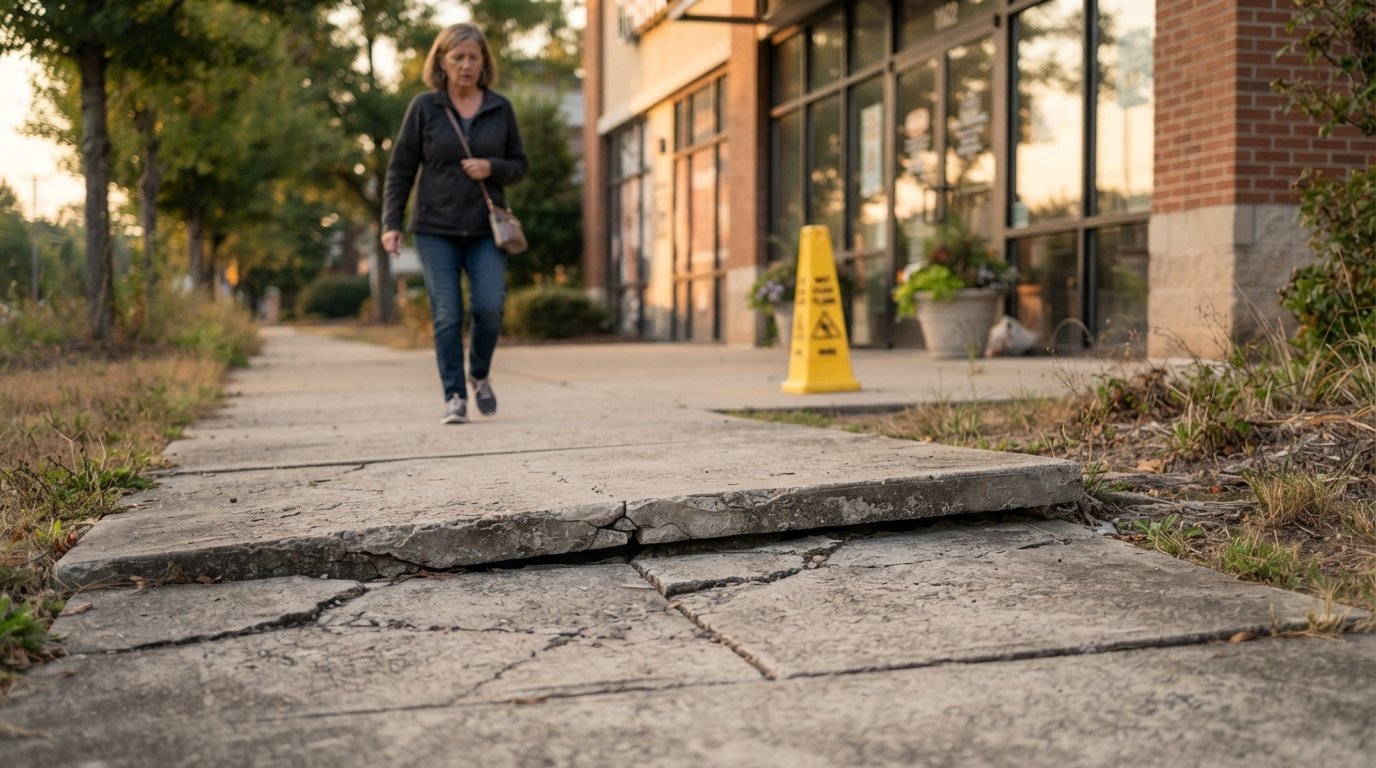
To prove constructive notice, you need evidence. This is where incident reports, surveillance footage, and witness statements become critical. If a spill sat in a busy aisle for hours, a jury may infer that employees should have seen it. If a cracked sidewalk has been unrepaired for months, the city or property owner likely had constructive notice. Without such evidence, your claim may struggle. This is why it is essential to document the scene immediately and request any records the property owner may have.
Common Defenses: Open and Obvious Conditions and Comparative Fault
Even if you can prove notice, property owners and their insurers will raise defenses to reduce or deny your claim. Two defenses are especially common: the open and obvious doctrine and comparative fault.
The open and obvious doctrine holds that a property owner has no duty to warn of hazards that are so obvious that a reasonable person would notice them. For example, if you trip over a large, brightly colored cord stretched across a hallway, the owner may argue that the danger was open and obvious and that you should have avoided it. However, the doctrine is not absolute. If the owner should have anticipated that a distracted person might not see the hazard, or if the condition was unreasonably dangerous, the doctrine may not apply. Courts also consider whether the owner created the distraction or whether the hazard was in a location where attention would naturally be elsewhere.
Comparative fault, also called comparative negligence, is another powerful defense. In most states, if you were partly at fault for your injury, your recovery is reduced by your percentage of fault. For instance, if you were texting while walking and fell on a wet floor, a jury might assign you 30 percent of the blame. Your compensation would then be reduced by 30 percent. In a few states that follow pure comparative fault, you can recover even if you were 99 percent at fault. In others, you are barred from recovery if you were more than 50 percent at fault. Understanding your state's rule is crucial because it directly affects the value of your claim.
Property owners may also argue that you were trespassing, that the hazard was trivial, or that you assumed the risk by engaging in an activity. Each defense requires a tailored response, which is why having an attorney review your case can make a significant difference.
How Medical Records and Incident Reports Support a Free Case Review
Building a strong slip and fall claim starts with evidence. Two types of documents are especially important: medical records and incident reports. When you request a free case review through a service like GoFreeLegal, having these records ready can help an attorney quickly assess the merits of your claim.
Medical records establish the nature and extent of your injuries, the treatment you received, and the link between the accident and your condition. They also help prove that your injuries were serious enough to warrant compensation. Without prompt medical attention, insurance companies may argue that your injuries were minor or unrelated to the fall. Incident reports, whether from a store, a landlord, or a police officer, capture the details of the accident while they are fresh. They may include witness statements, photographs, and notes about the hazard. If you reported the fall to the property owner, request a copy of the report. If they refuse, an attorney can help you obtain it through legal channels.
Gathering this evidence quickly is important because surveillance footage may be overwritten, witnesses may move, and hazards may be repaired. If you are considering a free case review, having a clear timeline and documentation will make the process smoother. For those injured in car crashes, truck wrecks, or related accidents, resources like AutoInjuryAccident can help connect you with attorneys who understand the nuances of accident claims, but for slip and fall cases, the same principle applies: the sooner you act, the better your chances of preserving evidence.
Steps to Take After a Slip and Fall Injury
If you are injured in a slip and fall, what you do in the hours and days afterward can significantly impact your claim. Here are practical steps to protect your health and your legal rights.
- Seek medical attention immediately. Your health comes first. Even if you feel fine, some injuries, like concussions or internal bleeding, may not be immediately apparent. A medical record also creates a link between the accident and your injuries.
- Report the incident. Notify the property owner, manager, or landlord. Ask for a copy of the incident report and take note of who you spoke with. If the police are called, request a copy of their report as well.
- Document the scene. Take photographs of the hazard, your injuries, and the surrounding area. Note lighting, floor conditions, and any warning signs (or lack thereof). Collect contact information from witnesses.
- Preserve evidence. Keep your shoes and clothing, and do not repair or discard anything that might be relevant. If possible, take photos of your injuries over time.
- Consult with an attorney. A free case review can help you understand your options and avoid mistakes that could harm your claim. An attorney can also handle communication with insurance companies and ensure deadlines are met.
Following these steps not only strengthens your claim but also demonstrates that you took the incident seriously. Insurance adjusters often look for inconsistencies or delays in reporting, so prompt action is key.
Understanding Damages in a Slip and Fall Claim
If you successfully prove liability, you may be entitled to various types of damages. These fall into two broad categories: economic and non-economic damages. Economic damages cover tangible losses, such as medical bills, lost wages, rehabilitation costs, and property damage. Non-economic damages compensate for intangible losses like pain and suffering, emotional distress, and loss of enjoyment of life. In some cases, punitive damages may be available if the property owner's conduct was particularly reckless or intentional, but these are rare in typical slip and fall cases.
Calculating damages is not always straightforward. Insurance companies often dispute the extent of injuries or argue that pre-existing conditions contributed to your symptoms. They may also undervalue non-economic damages. An experienced attorney can help you document your losses, consult with medical experts, and negotiate a fair settlement. Keep in mind that most states have a statute of limitations, typically two to three years from the date of injury, so you must act within that window or risk losing your right to sue.
In summary, a slip and fall injury claim under premises liability law requires proving that the property owner breached a duty of care and that you suffered damages as a result. Notice, comparative fault, and open and obvious defenses are common hurdles, but with strong evidence and legal guidance, you can pursue the compensation you deserve. If you are unsure where to start, consider reaching out for a free, confidential case review to explore your options without obligation.